My 100 Favorite Books
(Listed Alphabetically by Author)
(A work in progress)
- Author: Richard Adams
Title: Watership Down (1972)
Summary: A group of rabbits venture out to found a new warren.
My thoughts: I became very attached to these rabbits, which may have partially been due to the many voices my husband did when he read it aloud. I think the characters are distinct and likeable and the plot is full of exciting adventures and close calls.
Quote:
"El-ahrairah, your people cannot rule the world, for I will not have it so. All the world will be your enemy, Prince with a Thousand Enemies, and whenever they catch you, they will kill you. But first they must catch you, digger, listener, runner, prince with the swift warning. Be cunning and full of tricks and your people shall never be destroyed."
- Author: Margaret Atwood
Title: Alias Grace (1996)
Summary: A 16-year-old Canadian woman, Grace, is tried for the murder of her employer and his mistress. Is she guilty or is she innocent? That question lies at the heart of the book, which is narrated by the accused herself, the ultimate unreliable narrator.
My thoughts: I love a book that makes me think, and potentially even gives me opportunities to understand other ways of thinking and seeing the world, and this one does. I also appreciated the doubling and tripling of characters throughout the book, the most pervasive being Grace herself: Is she an innocent victim, an unrepentant murderess, or a madwoman? Atwood interweaves this basic question with many different characters, stories, and themes. I wanted to read the whole thing in one sitting!
Quote:
It is morning, and time to get up; and today I must go on with the story. Or the story must go on with me, carrying me inside it, along the track it must travel, straight to the end, weeping like a train and deaf and single-eyed and locked tight shut; although I hurl myself against the walls of it and scream and cry, and beg to God himself to let me out.
When you are in the middle of a story it isn't a story at all, but only a confusion; a dark roaring, a blindness, a wreckage of shattered glass and splintered wood; like a house in a whirlwind, or else a boat crushed by the icebergs or swept over the rapids, and all aboard powerless to stop it. It's only afterwards that it becomes anything like a story at all. When you are telling it, to yourself or to someone else.
- Author: Margaret Atwood
Title: Oryx and Crake (2003)
Summary: This is a story about a post-apocalyptic future in which only one human being survives, as far as he knows. There's a lot of stuff about genetic manipulation and other scientific stuff that's just an extension of what's already being done right now, but the most interesting part of the book is the remembered relationships between three friends.
My thoughts: I would never have imagined that a book about a man stranded alone could be so enthralling. The plot may sound familiar, but the main character is fascinating in his thoughts and memories. It jumps around in time, but it's done really well, so it isn't at all confusing.
Quote:
Out of habit he looks at his watch -- stainless-steel case, burnished aluminum band, still shiny although it no longer works. He wears it now as his only talisman. A blank face is what it shows him: zero hour. It causes a jolt of terror to run through him, this absence of official time. Nobody nowhere knows what time it is.
- Author: Margaret Atwood
Title: The Robber Bride (1993)
Summary: Three women tell stories about their lives and how their husbands were all stolen by the same woman.
My thoughts: Shannon and I took turns reading this book aloud to each other, and we were both amazed by how good the different voices were and how interesting the various stories were.
Quote:
Upon a pedestal or down on your knees, it's all a male fantasy: that you're strong enough to take what they dish out, or else too weak to do anything about it. Even pretending you aren't catering to male fantasies is a male fantasy: pretending you're unseen, pretending you have a life of your own, that you can wash your feet and comb your hair unconscious of the ever-present watcher peeping through the keyhole, peering through the keyhole in your own head, if nowhere else. You are a woman with a man inside watching a woman. You are your own voyeur.
- Author: Jane Austen
Title: Emma (1816)
Summary: A spoiled rich girl -- who is not so bad at heart -- greatly overestimates her own matchmaking abilities, and makes the mistake of meddling in other people's lives.
My thoughts: This was the first Jane Austen book I tried to read, when I was around 20 years old, and that first try was unsuccessful. I found the novel boring, as it seemed like nothing was happening. When I returned to the book several years later, I couldn't believe I'd ever found it boring. Now I love it. I love Austen's emotionally and morally complex characters and their relationships with those around them. I don't really see it as a love story, though that does happen at the end; I see it more of a social commentary.
Quote:
It was badly done, indeed! You, whom she had known from an infant, whom she had seen grow up from a period when her notice was an honour, to have you now, in thoughtless spirits, and the pride of the moment, laugh at her, humble her--and before her niece, too--and before others, many of whom (certainly some,) would be entirely guided by your treatment of her.--This is not pleasant to you, Emma--and it is very far from pleasant to me; but I must, I will,--I will tell you truths while I can.
- Author: Jane Austen
Title: Persuasion (1818)
Summary: After rejecting her lover's marriage proposal when she was a young woman, influenced by a family friend's discouragement, Anne Elliot has lived a life of duty and responsibility, with little romantic or familial love. When Frederick reenters her social circle several years later, Anne is well on her way to being an old maid, and Frederick shows little interest in her, much to Anne's chagrin, as she is still in love with him.
My thoughts: This is my favorite Austen novel, and Jane Austen is one of my very favorite authors, so that is high praise indeed. I'm often rather cynical when it comes to romantic stories, but this one is in my heart. I'm a sucker for unrequited love plots, and that's what most of this book is. The movie, starring Ciarán Hinds and Amanda Root, is also excellent.
Quote:
[Letter from Frederick:] I can listen no longer in silence. I must speak to you by such means as are within my reach. You pierce my soul. I am half agony, half hope. Tell me not that I am too late, that such precious feelings are gone for ever. I offer myself to you again with a heart even more your own, than when you almost broke it eight and a half years ago. Dare not say that man forgets sooner than woman, that his love has an earlier death. I have loved none but you. Unjust I may have been, weak and resentful I have been, but never inconstant.
- Author: Jane Austen
Title: Pride and Prejudice (1813)
Summary: Two sisters, surrounded by a rather embarrassing family, are unlikely to attract desirable suitors with their modest incomes. But when two wealthy men join their social circle, romance blooms.
My thoughts: I love the character of Darcy, how he hides how he truly feels, how he puts himself out there with Lizzie and is clearly hurt when his feelings are not returned, how he shows his goodness in helping her family, and how he holds out hope even after her rejection. Lizzie and Darcy are two of my favorite characters in fiction.
Quote:
It is a truth universally acknowledged, that a single man in possession of a good fortune, must be in want of a wife.
- Author: Andrea Barrett
Title: Ship Fever (1996)
Summary: A collection of historical short stories revolving around eighteenth- and nineteenth-century scientists, focused on "the love of science and the science of love."
My thoughts: The titular story -- which takes place primarily at a quarantine station -- was my favorite, beautifully told and moving, though the one about Mendel was wonderful, too.
Quote:
Annie disapproved of her mistress's actions almost entirely. Exposing herself to filth like that, walking through low parts of town with only a Quaker woman for a chaperone--no, it was not appropriate. Although it was just what you might expect from a woman brought up so irregularly. Mr. Rowley's mother would never have done such a thing.
- Author: Peter S. Beagle
Title: The Last Unicorn (1968)
Summary: This is the story of a quest, the search by the unicorn -- immortal, infinitely beautiful -- for her lost fellows. She is assisted in her mission by two humans, Schmendrick the Magician and Molly Grue.
My thoughts: A good story simply told. Though not as lyrical as some of my favorite books (such as McKillip's work), it is nonetheless an enjoyable story, filled with emotion and humor.
Quote:
Heroes know that things must happen when it is time for them to happen. A quest may not simply be abandoned; unicorns may go unrescued for a long time, but not forever; a happy ending cannot come in the middle of the story.
- Author: Anne Bishop
Title: The Black Jewels Trilogy:
- Daughter of the Blood (1998)
- Heir to the Shadows (1999)
- Queen of the Darkness (2000)
Summary: Seven hundred years ago, a Black Widow witch saw an ancient prophecy come to life in her web of dreams and visions. Now the Dark Realm readies itself for the arrival of its Queen, the Witch who will wield more power than even the High Lord of Hell himself. But the Queen is still young, still open to influence--and corruption. Whoever controls the Queen controls the Darkness. Three men--sworn enemies--know this. And they know the power that hides behind the blue eyes of an innocent young girl. And so begins a ruthless game of politics and intrigue, magic and betrayal, where the weapons are hate and love--and the prize could be terrible beyond imagining...
My thoughts: Okay. Not the best written books on this list, not by a long shot, and very melodramatic (the first book, in particular, made me roll my eyes many times -- sexual slavery, child rape, etc. -- but I continued on and am glad I did). It got better, and I became very attached to the characters. I'm sure I will read these books more than once (and I'm grateful to my friend Margie, who sent them to me).
Quote:
The eyes that met his were pained and haunted, full of a grieving that twisted his heart because he didn't know what caused it--or, perhaps, because he did.
- Author: Ray Bradbury
Title: Dandelion Wine (1957)
Summary: This semi-autobiographical novel is set in the fictional town of Green Town, Illinois, and centers around a 12-year-old boy living in small-town America in a bygone era. There isn't a lot of plot, but plenty of atmosphere.
My thoughts: I first read this book when I was 15, in my junior year English class with Mr. Larry Klevos, and it immediately became my favorite. It's nostalgic and lovely. It was definitely my favorite book for at least 10 years, though it eventually got competition from Ondaatje's The English Patient, Crowley's Little, Big, and others.
Quote:
A whole summer ahead to cross off the calendar, day by day. Like the goddess Siva in the travel books, he saw his hands jump everywhere, pluck sour apples, peaches, and midnight plums. He would be clothed in trees and bushes and rivers.
- Author: Ray Bradbury
Title: The Martian Chronicles (1950)
Summary: Sort of a novel, sort of a collection of short stories centering around Man's invasion of Mars.
My thoughts: Beautiful, sad, and evocative, with some of Bradbury's most lyrical writing.
Quote:
The rockets came like drums, beating in the night. The rockets came like locusts, swarming and settling in blooms of rosy smoke. And from the rockets ran men with hammers in their hands to beat the strange world into a shape that was familiar to the eye, to bludgeon away all the strangeness, their mouths fringed with nails so they resembled steel-toothed carnivores, spitting them into their swift hands as they hammered up frame cottages and scuttled over roofs with shingles to blot out the eerie stars, and fit green shades to pull against the night.
- Author: Ray Bradbury
Title: Something Wicked This Way Comes (1962)
Summary: A nightmarish traveling carnival comes to a small town and draws the attention of two 13-year-old boys. This book is partly a work of fantasy, partly a work of horror, and it focuses on the conflicting natures of good and evil, especially as they relate to the carnival's leader (Mr. Dark) and one of the boys' father (Charles Halloway).
My thoughts: This book is wonderfully sinister.
Quote:
The seller of lightning rods arrived just ahead of the storm. He came along the street of Green Town, Illinois, in the late cloudy October day, sneaking glances over his shoulder. Somewhere not so far back, vast lightnings stomped the earth. Somewhere, a storm like a great beast with terrible teeth could not be denied.
- Author: Marion Zimmer Bradley
Title: Mists of Avalon (1979)
Summary: The story of King Arthur, told from the perspective of Morgan le Fay.
My thoughts: The first time I read this book (in 1991), I found myself constantly wanting to read it. While eating, while going to class, while walking down the street, I wanted nothing more than to read this book. I was completely absorbed. I haven't read it a second time, so I don't know if it stands up to rereading, but I certainly loved it that first time.
Quote:
If you would have the message of the Gods to direct your life, look for that which repeats, again and again; for this is the message give you by the Gods, the karmic lesson you must learn for this incarnation. It comes again and again until you have made it part of your soul and your enduring spirit.
- Author: Mikhail Bulgakov
Title: The Master and Margarita (1973; written 1928-1940)
Summary: One hot spring, the devil arrives in Moscow, accompanied by a retinue that includes a beautiful naked witch and an immense talking black cat with a fondness for chess and vodka. The visitors quickly wreak havoc in a city that refuses to believe in either God or Satan. But they also bring peace to two unhappy Muscovites: one is the Master, a writer pilloried for daring to write a novel about Christ and Pontius Pilate; the other is Margarita, who loves the Master so deeply that she is willing literally to go to hell for him.
My thoughts: This is a wonderfully inventive story that takes place in a vividly described 1930s Soviet Union. I appreciated the fancy and humor.
Quote:
Night began covering the forests and meadows with its black kerchief. The night ignited sad little lights somewhere far below, alien lights that were no longer of any interest or use either to Margarita or the Master. Night overtook the cavalcade, spreading over them from above and scattering white specks of stars here and there in the saddened sky.
Night was thickening, flying alongside the riders, grabbing at their cloaks and pulling them off, unmasking all illusions. And whenever Margarita, buffeted by the cool breeze, opened her eyes, she saw the changes that were taking place in the appearances of all who were flying to their destination. And when the crimson full moon rose up to meet them from behind the edge of the forest, all illusions vanished and the magical, mutable clothing fell into the swamp and drowned in the mist.
- Author: A. S. Byatt
Title: Possession (1990)
Summary: Part historical as well as contemporary fiction, the title Possession refers to issues of ownership and independence between lovers, the practice of collecting historically significant cultural artifacts, and to the possession that a biographer feels of their subject. The novel incorporates many different styles and devices: diaries, letters and poetry, in addition to third-person narration. Possession is as concerned with the present day as it is with the Victorian era, pointing out the differences between the two time periods, satirizing such things as modern academia and mating rituals.
My thoughts: I like stories about scholars, particularly literary scholars, and this one is perhaps the best I've read. The love story isn't all it is, but that part of the story is well developed.
Quote:
I cannot bear not to know the end of a tale. I will read the most trivial things once commenced only out of a feverish greed to be able to swallow the ending sweet or sour and to be done with what I need never have embarked on. Are you in my case? Or are you a more discriminating reader? Do you lay aside the unprofitable?
- Author: Italo Calvino
Title: If on a Winter's Night a Traveler (1979)
Summary: This isn't really one novel, but ten, each with a different plot, style, ambiance, and author, each interrupted at a moment of suspece.
My thoughts: This novel is completely unexpected. It doesn't follow the normal narrative conventions, instead focusing largely on the concept of storytelling, including readers as characters. At first I found it disconcerting, but in the end I loved it.
Quote:
The seventh reader interrupts you: "Do you believe that every story must have a beginning and an end? In ancient times a story could end only in two ways: having passed all the tests, the hero and the heroine married, or else they died. The ultimate meaning to which all stories refer has two faces: the continuity of life, the inevitability of death.
- Author: Orson Scott Card
Title: Ender's Game (1985)
Summary: Set in Earth's future, the novel presents an imperiled humankind who have barely survived two conflicts with the Formics (an insectoid alien race also known as the "Buggers"). In preparation for an anticipated third invasion, an international fleet maintains a school to find and train future fleet commanders. The world's most talented children, including the novel's protagonist Ender Wiggin, are taken at a very young age to a training center known as the Battle School. There, teachers train them in the arts of war through increasingly difficult games including ones undertaken in zero gravity in the Battle Room where Ender's tactical genius is revealed.
My thoughts: I'm not generally a big science fiction fan -- I tend more toward literary fiction and fantasy -- but my book group read this book together and I just loved it, despite its very aggressive, war-like tone. I haven't read any of the sequels, because I've heard mixed things: one person told me to stop with Ender's Game or I'd be sorry, and another person told me that the later books were even better.
Quote:
Perhaps it's called the end of the world because it's the end of the games, because I can go to one of the villages and become one of the little boys working and playing there, with nothing to kill and nothing to kill me, just living there. As he thought of it, though, he could not imagine what "just living" might actually be. He had never done it in his life. But he wanted to do it anyway.
- Author: John Crowley
Title: Engine Summer (1979)
Summary: A post-apocalyptic coming-of-age tale.
My thoughts: I really enjoyed reading this book, and the reveal at the end really surprised and pleased me. It was one of those perfect reveals in which all the evidence was there from the beginning, but you just don't see it until the end.
Quote:
Asleep?
No. Awake. I was told to close my eyes. And wait, he said, till you're asked to open them.
Oh. You can open them now ... What do you see?
You.
Am I ...
You're like ... a girl I know. Taller. Are all the angels tall?
- Author: John Crowley
Title: Little, Big (1981)
Summary: A man marries into a family of people -- mostly women -- who have a close relationship with the fairy world.
My thoughts: Gabriel Garcia Marquez meets Ray Bradbury meets William Shakespeare meets Charles De Lint meets Isabelle Allende. This is my absolutely favorite book, full of beauty and mystery and passion and serenity and humor and everything that makes life worth living. Crowley writes like a poetic angel who sees the magical underpinnings of the everyday world, and entire sections of this book just beg to be read aloud for the pure enjoyment of the beauty of the language.
Quote:
"Love is a myth."
"Love is a myth," Grandfather Trout said. "Like summer."
"What?"
"In winter," Grandfather Trout said, "summer is a myth. A report, a rumor. Not to be believed in. Get it? Love is a myth. So is summer."
- Author: Robertson Davies
Title: Fifth Business (1970)
Summary: The back of the book I own describes this as "the story of a rational man who discovers that the marvelous is only another aspect of the real." In this book, the main character's guilt over a childhood incident drives him.
My thoughts: Robertson Davies is a great writer, and this is my favorite of his books I've read (though I liked World of Wonders quite a bit, too).
Quote:
My lifelong involvement with Mrs Dempster began at 5:58 o'clock p.m. on 27 December 1908, at which time I was ten years and seven months old.
- Author: Isak Dinesen
Title: Out of Africa (1937)
Summary: A Danish woman moves to East Africa to run a coffee plantation, which she continues even after she and her husband have separated.
My thoughts: I'd never found Africa particularly interesting, but this book made it all real to me. I loved the main character as well as the people who surrounded her, and the writing is lovely throughout.
Quote:
The cure for anything is salt water: sweat, tears or the sea.
- Author: Umberto Eco
Title: Foucault's Pendulum (1988)
Summary: Three scholarly friends decide to make up their own complicated conspiracy theory, eventually largely forgetting that it is just a game. Other conspiracy theorists take them seriously, as well.
My thoughts: I found this book a bit difficult to read, as I was constantly trying to keep track of a million things at once. But I found the conspiracy theories interesting and the writing excellent. I haven't tried to read it a second time, but perhaps I will soon.
Quote:
I watched with reverence and fear. In that instant I was convinced that Jacopo Belbo was right. What he told me about the Pendulum I had attributed to esthetic raving, to the shapeless cancer taking gradual shape in his soul, transforming the game into reality without his realizing it. But if he was right about the Pendulum, perhaps all the rest was true as well: the Plan, the Universal Plot. And in that case I had been right to come here on the eve of the summer solstice. Jacopo Belbo was not crazy; he had simply, through his game, hit upon the truth.
- Author: Louise Erdrich
Title: Love Medicine (1984)
Summary: A series of disjointed but interconnected narratives, each told by a different character and each taking place in a different time period (ranging from the 1930s to the present day), telling the stories of several families living on an Indian reservation.
My thoughts: I love Louise Erdrich's non-linear narratives, the way she looks at things from multiple perspectives. This wasn't the first of her books that I read (that was Tales of Burning Love), but I think it's my favorite.
Quote:
His thoughts swam between us, hidden under rocks, disappearing in weeds, and I was fishing for them, dangling my own words like baits and lures.
- Author: Jasper Fforde
Title: The Eyre Affair (2001)
Summary: Literary detective Thursday Next pursues a master criminal through the world of Charlotte Brontë 's Jane Eyre.
My thoughts: It's sort of soft science-fiction, sort of literary in-joke, sort of revised history, sort of detective story a là the early "Anita Blake" novels. It's made me laugh out loud several times, which is unusual for me. At first, it seemed a bit pretentious and I was lost amid all the historical and literary references, but it settled down after a while and I got most of the jokes. It helps that a lot of them are Shakespearean.
Quote: This is a bit about "bookworms," maggot-like buggers invented to process and interpret language and books. It's probably only amusing to other grammar nerds, but I found it funny:
... Several people have asked me where I find the large quantity of prepositions that I need to keep my Bookworms fit and well. The answer is, of course, that I use omitted prepositions which, when mixed with dropped definite articles, make a nourishing food. There are a superabundance of these in the English language. Journey's end, for instance, has one omitted preposition and two definite articles: the end of the journey. There are many other examples, too, such as bedside (the side of the bed) and streetcorner (the corner of the street), and so forth. If I run short I head to my local newspapers, where omitted prepositions can be found in The Toad's headlines every day. As for the worm's waste products, these are chiefly composed of apostrophes -- something that is becoming a problem -- I saw a notice yesterday that read Cauliflower's, three shilling's each ...
- Author: E. M. Forster
Title: Maurice (1913)
Summary: A basic period-piece love story -- or, rather two consecutive love stories except that the love story involves two men, which was mostly unheard-of in English literature at the time this book was written and it was therefore not published in the author's lifetime.
My thoughts: Though I am a straight woman of the 21st century, I identified closely with the main character. He feels things the same way I feel them, searches for his own identity in the same ways that I have searched, and so he felt very real to me and very true.
Quote:
They lay side by side without touching. Presently Clive said, "It's no better here. I shall go." Maurice was not sorry, for he could not get to sleep either, though for a different reason, and he was afraid Clive might hear the drumming of his heart, and guess what it was.
- Author: E. M. Forster
Title: A Room with a View (1908)
Summary: A young English girl and her chaperone go on a trip to Florence, Italy, where they meet a young Englishman and his father. A silent romance is struck up between the two young people, but when they return to England the girl becomes engaged to someone else.
My thoughts: I love the society described in this book, the societal expectations, the rigid rules ... and the flouting of these. It's a romance, but also a social commentary.
Quote:
Have you ever noticed that there are people who do things which are most indelicate, and yet at the same time - beautiful?
- Author: Brian Friel
Title: Translations (1980)
Summary: This play explores the failed meeting of English and Irish cultures, the English efforts to convert all Irish place names into English, and the love affair between an Irish woman who speaks no English and an English soldier who speaks no Irish.
My thoughts: I always enjoy stories about words (one of the reasons I enjoy Tom Stoppard's work), and this one is excellent. I don't think it's very well known, but I particularly enjoy it.
Quote:
Yolland: Even if I did speak Irish I'd always be an outsider here, wouldn't I? I may learn the password but the language of the tribe will always elude me, won't it? The private core will always be ... hermetic, won't it?
- Author: Max Frisch
Title: Man in the Holocene (1979)
Summary: This story of a man's decline into senility is communicated through not only straightforward text but also lists, dictionary entries, illustrations, encyclopedia entries, etc.
My thoughts: Normally, I can't stand experimental literary stuff, because it seems so pretentious. But I read this slim little book slowly and with growing awe as it chronicled an elderly man's crumbling memory and thoughts. Words simply cannot describe this book. It is powerful and important and very, very deeply moving. It may in fact be my second favorite book on this list (after John Crowley's Little, Big).
Quote:
The ants Geiser recently observed under a dripping fir tree are not concerned with what anyone might know about them; nor were the dinosaurs, which died out before a human being set eyes on them. All the papers, whether on the wall or on the carpet, can go. Who cares about the Holocene? Nature needs no names. Geiser knows that. The rocks do not need his memory.
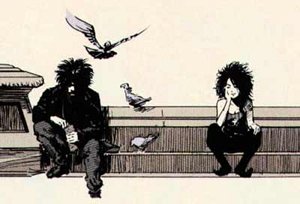 Author: Neil Gaiman Author: Neil Gaiman
Title: The Sandman series
- Preludes and Nocturnes (1988-1989)
- The Doll's House (1989-1990)
- Dream Country (1990)
- Season of Mists (1990-1991)
- A Game of You (1991-1992)
- Fables and Reflections (1991-1993)
- Brief Lives (1992-1993)
- Worlds' End (1993)
- The Kindly Ones (1994-1995)
- The Wake (1995-1996)
Summary: This is the story of Morpheus, also known as Dream, one of the Endless, who are anthropomorphic personifications of natural forces (Destiny, Death, Dream, Destruction, Despair, Desire, and Delirium). The author describes the plot as "The Lord of Dreams learns that one must change or die, and makes his decision."
My thoughts: Wow. This series has been described as "a comic book for intellectuals." It's deeply mythic, moving, challenging, and excellently written.
Quote:
Choronzon: I am anti-life, the beast of judgement. I am the dark at the end of everything. The end of universes, gods, worlds ... of everything. And what will you be then, Dreamlord?
Dream: I am hope. - Author: Natalie Goldberg
Title: Writing Down the Bones (1986)
Summary: A guide to writing, with a Buddhist slant.
My thoughts: Natalie Goldberg in this book is so encouraging, so inspiring, that I've read the book more than once. I highly recommend it.
Quote:
We are important and our lives are important, magnificent really, and their details are worthy to be recorded. This is how writers must think, this is how we must sit down with pen in hand. We were here; we are human beings; this is how we lived. Let it be known, the earth passed before us. Our details are important. Otherwise, if they are not, we can drop a bomb and it doesn't matter. . . Recording the details of our lives is a stance against bombs with their mass ability to kill, against too much speed and efficiency. A writer must say yes to life, to all of life: the water glasses, the Kemp's half-and-half, the ketchup on the counter. It is not a writer's task to say, "It is dumb to live in a small town or to eat in a café when you can eat macrobiotic at home." Our task is to say a holy yes to the real things of our life as they exist the real truth of who we are: several pounds overweight, the gray, cold street outside, the Christmas tinsel in the showcase, the Jewish writer in the orange booth across from her blond friend who has black children. We must become writers who accept things as they are, come to love the details, and step forward with a yes on our lips so there can be no more noes in the world, noes that invalidate life and stop these details from continuing.
- Author: William Goldman
Title: The Princess Bride (1973)
Summary: A spoiled, beautiful girl and her farmboy servant fall in love, followed by several adventures involving other interesting characters.
My thoughts: So much funnier than the movie, as it is filled with faux authorial asides that wouldn't translate well to a film. It's far less romantic than the movie, but arguably better.
Quote:
"Has it got any sports in it?"
"Fencing. Fighting. Torture. Poison. True love. Hate. Revenge. Giants. Hunters. Bad men. Good men. Beautifulest ladies. Snakes. Spiders. Beasts of all natures and descriptions. Pain. Death. Brave men. Coward men. Strongest men. Chases. Escapes. Lies. Truths. Passion. Miracles."
- Author: Thich Nhat Hanh, et. al.
Title: For a Future to Be Possible: Commentaries on the Five Mindfulness Trainings
Summary: The Five Mindfulness Trainings--protecting life, acting with generosity, behaving responsibly in sexual relationships, speaking and listening deeply and mindfully, and avoiding substance abuse--are the basic statement of ethics and morality in Buddhism.
My thoughts: When I first read this book, I was at Green Gulch Farm, a zen retreat up in Marin, and that is when I decided to become vegetarian. That only lasted a couple of years, but I still feel strongly about it. I find this book an excellent guide to living a mindful life.
Quote:
The third part of the practice is to prescribe for yourself a kind of diet. Aware of the fact that there are this many toxins in my body and consciousness, aware of the fact that I am ingesting this and that toxin into my body and consciousness every day, making myself sick and causing suffering to my beloved ones, I am determined to prescribe for myself a proper diet. I vow to ingest only items that preserve well-being, peace, and joy in my body and my consciousness. I am determined not to ingest more toxins into my body and consciousness.
- Author: Thich Nhat Hanh
Title: Peace Is Every Step: The Path of Mindfulness in Everyday Life
Summary: Thich Nhat Hanh explores how to be aware of the connectedness of all beings so that we can behave mindfully in our lives.
My thoughts: This is my favorite Thich Nhat Hanh book, because it really speaks to me. I like what Thich Nhat Hanh says about everything being potential meditation. He mentions washing the dishes, and suggests just paying attention to the sensations of the warm water, the feel of the plate in our hand ... and if you do this mindfully, then even doing the dishes can be a meditation. In a field in which writing tends to be rather abstract and idealistic, Thich Nhat Hanh is delightfull concrete, bringing mindfulness into the real world.
Quote:
We can smile, breathe, walk, and eat our meals in a way that allows us to be in touch with the abundance of happiness that is available. We are very good at preparing to live, but not very good at living. We know how to sacrifice ten years for a diploma, and we are willing to work very hard to get a job, a car, a house, and so on. But we have difficulty remembering that we are alive in the present moment, the only moment there is for us to be alive. Every breath we take, every step we make, can be filled with peace, joy, and serenity. We need only to be awake, alive in the present moment.
- Author: Eric Hansen
Title: Stranger in the Forest: On Foot Across Borneo (1988)
Summary: Eric Hansen was the first westerner to walk across the island of Borneo, which he did largely with the aid of a local guide.
My thoughts: Eric Hansen has a great self-deprecating sense of humor, and he delights in describing faux pas he made and pickles he got himself into. His descriptions of his adaptation to different cultural situations are fascinating.
Quote:
The drinking continued, and a man went berserk. He punched two men before being restrained by five others. Ten feet from where we sat he was tied to a post with jungle vines. They left him to kick and scream, and he exhausted himself in about fifteen minutes. No one took any notice, and half an hour later he was sitting peacefully at the base of the post. A man then approached him to see if he had calmed down, and after a short, whispered conversation he was untied. The man who had gone berserk joined the party as if nothing unusual had happened; he was fine for the rest of the evening.
- Author: Eric Hansen
Title: Motoring with Mohammed (1992)
Summary: In 1978 Eric Hansen found himself shipwrecked on a desert island in the Red Sea. When goat smugglers offered him safe passage to Yemen, he buried seven years' worth of travel journals deep in the sand and took his place alongside the animals on a leaky boat bound for a country that he'd never planned to visit. 10 years later, his journey back to retrieve the journals is filled with extraordinary characters and offbeat situations, all of which he describes with his usual wit.
My thoughts: I'll repeat what I said about Stranger in the Forest: Eric Hansen is clever and self-deprecating. He describes situations so vividly that you can't help but get sucked in.
Quote:
There is no such thing as knowing "the real story" in Yemen. There are far too many versions from which to choose. Motivations vary; mystery remains a constant.
- Author: Ursula Hegi
Title: Stones from the River (1994)
Summary: This is the story of a dwarf -- a storyteller who tells tales both true and fictional -- who lives in the fictional small town of Burgdorf, Germany, through the first half of the twentieth century, beginning with the ending of the first World War and continuing through the second. The novel is an intimate look at what it was like for ordinary people to live through the rise of Adolf Hitler and the devastation wrought by the Third Reich.
My thoughts: It's one of those books that makes me not want to start another book immediately after I finish it, because I want this one to settle in my memory and in my thoughts.
Quote:
In St. Martin's Church, Herr Pastor Beier continued to offer prayers for the soldiers who'd died in the war, but he never mentioned the Jews who'd been deported or killed. Standing on the blood-red carpet that led up the marble stairs to the black marble altar, he'd raise both fleshy arms and beseech Christus to embrace the soldiers who'd sacrificed their lives for the Vaterland, just as He had sacrificed His life on the cross.
- Author: Mark Helprin
Title: Winter's Tale (1983)
Summary: Peter Lake, a burglar with a heart of gold in a mythical New York, meets a mysterious white horse who saves his life and becomes his guardian. He then meets a woman named Beverly Penn, and they fall in love with each other. Further adventures ensue.
My thoughts: This book is magical ... well, magical realism, to be precise. The central romance never meant much to me, but I enjoy Peter's story for itself.
Quote:
Winter then in its early and clear stages, was a purifying engine that ran unhindered over city and country, alerting the stars to sparkle violently and shower their silver light into the arms of bare upreaching trees. It was a mad and beautiful thing that scoured raw the souls of animals and man, driving them before it until they loved to run. And what it did to Northern forests can hardly be described, considering that it iced the branches of the sycamores on Chrystie Street and swept them back and forth until they rang like ranks of bells.
- Author: Robin Hobb
Title: The Farseer Trilogy and The Tawny Man Trilogy
- Assassin's Apprentice (1995)
- Royal Assassin (1996)
- Assassin's Quest (1997)
and
- Fool's Errand (2002)
- Golden Fool (2003)
- Fool's Fate (2003)
Summary: Fitz, the bastard son of Prince Chivalry, is raised in the stables until the king decides to train him as an assassin. He serves the crown loyally and secretly, and always seems to be in danger of his life.
My thoughts: I love the characters in this series, especially Fitz, the Fool, and Nighteyes. There's a second trilogy, The Liveship Traders, which falls between these two, but I didn't find it very interesting (largely because Fitz wasn't in it). I wouldn't say these series are great literature, but I loved reading them and actively began searching for similar works when I had finished, because I hated that they were over.
Quote:
He caught his breath and said, "There it is. Plainly, Fitz, I told you I set no limits on my love for you. I don't. Yet I never expected you to offer me your body. It was the whole of your heart, all for myself, that I sought. Even though I never had a right to it."
- Author: Victor Hugo
Title: Les Miserables (1862)
Summary: The novel focuses on the struggles of ex-convict Jean Valjean and his experience of redemption. It examines the nature of law and grace, and expounds upon the history of France, architecture of Paris, politics, moral philosophy, antimonarchism, justice, religion, and the types and nature of romantic and familial love.
My thoughts: This story is a grand heroic journey. I wasn't very interested in the romance, but I loved Jean Valjean.
Quote:
Nothing discernable to the eye of the spirit is more brilliant or obscure than man; nothing is more formidible, complex, mysterious, and infinite. There is a prospect greater than the sea, and it is the sky; there is a prospect greater than the sky, and it is the human soul.
- Author: Aldous Huxley
Title: Brave New World (1932)
Summary: In a society in which all people are divided into five castes -- Alphas, Betas, Gammas, Deltas, and Epsilons -- the highest caste is allowed to develop naturally, but all lower castes are treated to chemical interference to arrest intelligence or physical growth. Individuality is vigorously discouraged. The introduction of a "savage" complicates things.
My thoughts: I enjoy the complete world the author has created, and find the book thought-provoking.
Quote:
"My dear young friend," said Mustapha Mond, "civilization has absolutely no need of nobility or heroism. These things are symptoms of political inefficiency. In a properly organized society like ours, nobody has any opportunities for being noble or heroic. Conditions have got to be thoroughly unstable before the occasion can arise."
- Author: David Henry Hwang
Title: M. Butterfly (1988)
Summary: A sort of response to the opera Madame Butterfly, this is an almost entirely two-character play about the relationship between a Western man and his Asian mistress.
My thoughts: This play explores the relationship between East and West, between men and women, and takes a hard look at the assumptions we make about each other. I saw it performed at the American Conservatory Theater, and it was brilliant. I have read it a few times since then.
Quote:
"It's one of your favorite fantasies, isn't it? The submissive Oriental woman and the cruel white man."
- Author: Kazuo Ishiguro
Title: Never Let Me Go (2005)
Summary: A young woman attending an unusual boarding school gradually reveals her purpose in life.
My thoughts: Like the guardians within it, this book doles out information in doses sometimes before you're ready to understand it, so that it all sinks in slowly. It's beautifully done.
Quote:
"You've been told about it. You're students. You're ... special. So keeping yourselves well, keeping yourselves very healthy inside, that's much more important for each of you than it is for me."
- Author: Jennifer Johnston
Title: The Illusionist (1995)
Summary: Stella is painfully aware of the mystery surrounding her unreachable, illusionist husband with whom she is infatuated. ... As every day Martyn's double life becomes more apparent, a vicious game develops between these desolate figures, which soon evolves into a fight for survival.
My thoughts: This is a very unusual book, sometimes a bit strange, but always lyrical and insightful.
Quote:
Maybe he had no childhood to remember, that was always the impression that he gave, a man whose life was wholly in the future, unrolling in front of him like some brand-new motorway.
- Author: Diana Wynne Jones
Title: Howl's Moving Castle (1986)
Summary: An evil witch transforms the young Sophie Hatter into an old crone, leaving her to abandon her life and set out to seek her fortune. She gets a sort of "job" (she's not really hired; she just shows up and starts working) as a cleaning lady for the infamous Wizard Howl, who is thought to eat the hearts of beautiful young women but who is actually under a terrible curse.
My thoughts: I love fairy tales, and this is a creative one. I saw the Miyazaki movie first and loved it, but found some things confusing. My friend Louise recommended that I read the book (and gave it to me as a gift), and I loved it much much more than the film. I realized that the movie was confusing because they'd had to cut so much in order to make it a reasonable length. The book is considerably longer, but also considerably better.
Quote:
In the land of Ingary where such things as seven-league boots and cloaks of invisibility really exist, it is quite a misfortune to be born the eldest of the three. Everyone knows you are the one who will fail first, and worst, if the three of you set out to seek your fortunes.
- Author: Ken Kesey
Title: One Flew Over the Cuckoo's Nest (1962)
Summary: Told from the perspective of a mostly-silent Native American patient in a terrible mental hospital, this story explores what happens when a man is brought in with an unbreakable spirit.
My thoughts: As with a number of other books on this list (The English Patient, Howl's Moving Castle, etc.) I loved this book far more than the film version that was made of it (though the actors in the film were quite good). The book is considerably more bizarre, because it is told from the perspective of someone who is mentally ill. It's a wonderful, depressing, inspiring story.
Quote:
While McMurphy laughs. Rocking farther and farther backward against the cabin top, spreading his laugh out across the water ‹ laughing at the girl, at the guys, at George, at me sucking my bleeding thumb, at the captain back at the pier... and the Big Nurse and all of it. Because he knows you have to laugh at the things that hurt you just to keep yourself in balance, just to keep the world from running you plumb crazy. He knows there's a painful side; he knows my thumb smarts and his girlfriend has a bruised breast and the doctor is losing his glasses, but he won't let the pain blot out the humor no more'n he'll let the humor blot out the pain.
- Author: Stephen King
Title: It (1986)
Summary: Seven children are terrorized by a malevolent evil that can take many forms but often appears as "Pennywise the Dancing Clown" and lives in the sewers, preying on children. The story takes place during two distinct time periods: one when the characters were children (1958) and another when they are adults (1985), battling the same evil.
My thoughts: I love non-linear plotting, and this book is a good example, as it shifts between two different time periods and seven main characters. It's very creepy, and I enjoyed the camaraderie of the main characters.
Quote:
"Maybe that's why God made us kids first and built us close to the ground, because He knows you got to fall down a lot and bleed a lot before you learn that one simple lesson. You pay for what you get, you own what you pay forŠ and sooner or later whatever you own comes back home to you."
- Author: Stephen King
Title: The Stand (1978)
Summary: A post-apocalyptic science fiction/horror/adventure novel with a large cast of characters in an epic battle between good and evil.
My thoughts: This book is very mythic, concretizing large themes with individual characters and events. I love a good fairy tale, and this is like one.
Quote:
"Show me a man or a woman alone and I'll show you a saint. Give me two and they'll fall in love. Give me three and they'll invent the charming thing we call 'society'. Give me four and they'll build a pyramid. Give me five and they'll make one an outcast. Give me six and they'll reinvent prejudice. Give me seven and in seven years they'll reinvent warfare. Man may have been made in the image of God, but human society was made in the image of His opposite number, and is always trying to get back home."
- Author: Maxine Hong Kingston
Title: The Woman Warrior: Memoirs of a Girlhood Among Ghosts (1976)
Summary: This fictionalized third-person autobiography explores what it means to grow up Chinese in the United States.
My thoughts: This book is largely about telling stories -- stories about our heroes and heroines, our family members, and those who are different from us -- and what stories mean to us and about us. The exploration of Chinese folklore and how it relates to the heroine is graceful and moving, and the writing is beautiful.
Quote:
When we Chinese girls listened to the adults talk-story, we learned that we failed if we grew up to be but wives or slaves. We could be heroines, swordswomen. Even if she had to rage across all China, a swordsoman got even with anybody who hurt her family. Perhaps women were once so dangerous that they had to have their feet bound....
- Author: Ursula K. Le Guin
Title: The Left Hand of Darkness (1969)
Summary: The protagonist, an emissary from a far-off world, is exposed to the alien and threatening culture of the androgynous inhabitants of the world of Gethen.
My thoughts: Exploring pride, patriotism, and love (among other issues), this book focuses on two complex, interesting characters and their relationship with each other. It's a quick read, but thought-provoking.
Quote:
A man wants his virility regarded, a woman wants her femininity appreciated, however indirect and subtle the indications of regard and appreciation. On Winter they will not exist. One is respected and judged only as a human being. It is an appalling experience.
- Author: Jonathan Lethem
Title: As She Climbed Across the Table (1997)
Summary: A science fiction love story centering around "Lack," a seemingly sentient void, or black hole, which has been created by a group of physicists, and which competes with our hero for the heroine's affections.
My thoughts: This is by far my favorite of Lethem's books. I found the love triangle inventive and the characters engaging. The ending of the book produced in me such an upsurge of feeling that I wanted to re-read the book immediately after I'd finished it for the first time.
Quote:
Blindness, which had been a flat, two-dimensional thing, a sheet of black paper suspended between me and the world, had been folded into an origami model of reality, a model that filled and replaced the very thing on which it was based. The universe. The real. And me, too. I was not only in the void, I apparently was the void. And the void was me.
- Author: Jonathan Lethem
Title: Gun, with Occasional Music (1994)
Summary: Conrad Metcalf has problems. He has a monkey on his back, a rabbit in his waiting room, and a trigger-happy kangaroo on his tail. (Maybe evolution therapy is not such a good idea.) He's been shadowing Celeste, the wife of an affluent Oakland urologist. Maybe falling in love with her a little at the same time. When the doctor turns up dead, Metcalf finds himself caught in a crossfire between the boys from the Inquisitor's Office and gangsters who operate out of the back room of the Fickle Muse.
My thoughts: This is what Raymond Chandler would have written if he was interested in science fiction. The hardboiled gumshoe protagonist is straight out of Phillip Marlowe's books, but in a world with genetically altered green kangaroos and other scientific marvels. It's fun to see the new take on the P.I. trope, but it's also just plain funny.
Quote:
Nobody said anything while I opened the bag and took out the egg salad sandwich. It was one of those funny moments when a bit of normal human activity embarrasses everybody out of their bluster and hostility, and roles are momentarily laid aside.
- Author: Primo Levi
Title: Survival in Auschwitz> (1947)
Summary: In 1943, Primo Levi, a twenty-five-year-old chemist and "Italian citizen of Jewish race," was arrested by the Italian Fascists and deported from his native Turin to Auschwitz. Levi was spared the gas chambers because his technical training was deemed useful for work in the I. G. Farben laboratories of Hitler's Third Reich. This book is Levi's classic account of his ten months in the German death camp, a harrowing story of systematic cruelty and miraculous survival.
My thoughts: This book is stark and simple, but incredibly moving. It is sometimes difficult to read, but I believe it is immensely important.
Quote:
Just as our hunger is not that feeling of missing a meal, so our way of being cold has need of a new word. We say "hunger," we say "tiredness," "fear," "pain," we say "winter" and they are different things. They are free words, created and used by free men who lived in comfort and suffering in their homes. If the Lagers had lasted longer a new, harsh language would have been born; and only this language could express what it means to toil the whole day in the wind, with the temperature below freezing, wearing only a shirt, underpants, cloth jacket and trousers, and in one's body nothing but weakness, hunger and knowledge of the end drawing nearer.
- Author: C. S. Lewis
Title: Till We Have Faces (1956)
Summary: A timeless tale of two princesses -- one beautiful and one unattractive -- which is a reworking of the classical myth of Cupid and Psyche, told from the perspective of Psyche's sister.
My thoughts: I love reworkings of fairy tales, and this one is very well written.
Quote:
Yet it surprised me that he should have said it; for I did not yet know that, if you are ugly enough, all men (unless they hate you deeply) soon give up thinking of you as a woman at all.
- Author: Gabriel Garcia Marquez
Title: Love in the Time of Cholera (1985)
Summary: A woman rejects a suitor who is very much in love with her and instead marries a very rational man who is less romantic and fanciful. The man she rejected in her youth continues to love her throughout their lives, corresponding with her through letters.
My thoughts: I love Gabriel Garcia Marquez. His magical realism and romantic tone just appeal to me.
Quote:
He allowed himself to be swayed by his conviction that human beings are not born once and for all on the day their mothers give birth to them, but that life obliges them over and over again to give birth to themselves.
- Author: Gabriel Garcia Marquez
Title: One Hundred Years of Solitude (1967)
Summary: A family struggles in their fictional town of Macondo.
My thoughts: Marquez's use of time in this story is fascinating, as time sometimes lapses, changes speeds, or stops altogether. I love his books, and this is my favorite of his novels (though I love his 1993 short story collection Strange Pilgrims, too).
Quote:
Carmelia Montiel, a twenty-year-old virgin, had just bathed in orange-blossom water and was strewing rosemary leaves on Pilar Ternera's bed when the shot rang out. Aureliano José had been destined to find with her the happiness that Amaranta had denied him, to have seven children, and to die in her arms of old age, but the bullet that entered his back and shattered his chest had been directed by a wrong interpretation of the cards.
- Author: Patricia A. McKillip
Title: Alphabet of Thorn (2004)
Summary: Deep inside a palace on the edge of the world, the orphan Nepenthe pores over books in the royal library, translating their languages and learning their secrets. Now sixteen, she knows little of the outside world--except for the documents that traders and travelers bring her to interpret. ... Then, during the coronation of the new Queen of Raine, a young mage gives Nepenthe a book that has defied translation. Written in a language of thorns, it speaks to Nepenthe's soul--and becomes her secret obsession. And, as the words escape the brambles and reveal themselves, Nepenthe finds her destiny entwined with that of the young queen's. Sooner than she thinks, she will have to choose between the life she has led and the life she was born to lead...
My thoughts: Like most of McKillip's books, this one is mysterious until it all comes together at the end. I found the characters and the plot interesting.
Quote:
On Dreamer's Plain, the gathering of delegations from the Twelve Crowns of Raine for the coronation of the Queen of Raine looked like an invading army. So the young transcriptor thought, gazing out a window as she awaited a visiting scholar.
- Author: Patricia A. McKillip
Title: The Book of Atrix Wolfe (1995)
Summary: Horrified after unwittingly bringing destruction to his land, Atrix Wolfe fled to the seclusion of the mountains. Now the Queen of the Wood summons the mage to find her lost daughter and reunite the kingdom of Faery--a quest that could finally free Atrix Wolfe from his pain.
My thoughts: A lyrical fairy tale full of vivid imagery. At first I found it somewhat confusing, due to all the dreams and visions, but the style grew on me. It's my favorite of McKillip's books.
Quote:
"I have seen him, once or twice, in this pool. And I saw him the night I hunted you. Part of him still remembers my wood. I wonder, if he tries to find his way back here, what might stop him from a wild hunt for his lost memories."
- Author: Patricia A. McKillip
Title: The Forgotten Beasts of Eld (1974)
Summary: Sixteen when a baby is brought to her to raise, Sybel has grown up on Eld Mountain. Her only playmates are the creatures of a fantastic menagerie called there by wizardry. Sybel has cared nothing for humans, until the baby awakens emotions previously unknown to her. And when Coren--the man who brought this child--returns, Sybel's world is again turned upside down.
My thoughts: An emotionally complex story about love and power, this book made me cry repeatedly. It isn't as lyrical as her later books, but I still found the plot interesting and satisfying.
Quote:
Her mouth tightened. "I will not draw Coren into the whirlpool of my anger and hatred. No revenge of his making could satisfy me, and it is purposeless involving him in mine. I want--I want to keep him free of hate. He--the night we flew the Dragon, we dropped downward suddenly, rushing toward darkness as though toward the endless deep of the night, blind, helpless, as you are when there is nothing left of you but the unhidden center of yourself--and from the core of him came a living, joyous laughter. Lost in his own hate for Drede, he could not have laughed like that. He may fight in this war simply because if he refused to fight for my sake and you died at battle, he would never forgive himself for not being with you. But I will give him no great cause to fight for. I will not drag him through his grief and bitterness again. He has given me so much love. At least I can give him that one protection."
- Author: Patricia A. McKillip
Title: The Riddle-Master Trilogy
- The Riddle-Master of Hed (1976)
- Heir of Sea and Fire (1977)
- Harpist in the Wind (1979)
Summary: A simple farmer who excels at riddles travels with the High One's harper to try to save his world from evil forces.
My thoughts: All three of the books in this trilogy are written fairly simply, though I saw glimmerings of the lyrical style McKillip later developed. All the mysteries of the series are resolved in the final book so magically and wonderfully that I was amazed. It made me want to sit down and read the whole trilogy again.
Quote:
If you have no faith in yourself, then have faith in the things you call truth. You know what must be done. You may not have courage or trust or understanding or the will to do it, but you know what must be done. You can't turn back. There is no answer behind you. You fear what you cannot name. So look at it and find a name for it. Turn your face forward and learn. Do what must be done.
- Author: Patricia A. McKillip
Title: Song for the Basilisk (1998)
Summary: As a child, Rook had been taken in by the bards of Luly, and raised as one of their own. Of his past he knew nothing‹except faint memories of fire and death that he'd do anything to forget. But nightmares, and a new threat to the island that had become his own, would not let him escape the dreadful fate of his true family. Haunted by the music of the bards, he left the only home he knew to wander the land of the power-hungry Basilisk who had destroyed his family. And perhaps, finally, to find a future in the fulfillment of his forgotten destiny...
My thoughts: This seems a sort of middle ground between McKillip's early, straightforward work (such as the Riddle-Master books) and her later, lyrical books. It's more on the lyrical side, but not to the extent of The Book of Atrix Wolfe. The plot is good and the ending made me stop and think and appreciate.
Quote:
Around them in every mirror, pieces of an enormous, winter-white beast began to form: a great, fiery eye here, there a claw that spanned the mirror, a haunch, a line of spurs along the scaled back, the fold of a wing. Caladrius fought against the shrilling, panicking crowd to reach Hollis, who had found his way off the abandoned stage, looking dazed, spellbound by his own spell. Some of the guards had struggled through to surround the prince and his children.
Watching a claw emerge from the mirror, one shouted, "Break the mirrors!"
They shattered instantly at an impatient gesture from the prince, thundering out of the massive frames to the floor. From every piece the beast looked out.
- Author: Patricia A. McKillip
Title: Winter Rose (1996)
Summary: A young man comes to rebuild his family estate, stirring memories of the curse his grandfather made and drawing the obsessed attention of the free-spirited Rois Melior who roams the woods wild and barefoot.
My thoughts: This book is like a romance between a young woman and the mysterious woods which she enters and departs more easily than other people in her town. I love McKillip's attention to nature and Rois's connection to it.
Quote:
My name is Rois, and I look nothing like a rose. The water told me that. Water never lies. I look more like a blackbird, with my flighty black hair and eyes more amber than the blackbird's sunny yellow. My skin is not fit for fairy tales, since I liked to stand in light, with my eyes closed, my face turned upward toward the sun. That's how I saw him at first: as a fall of light, and then something shaping out of the light. So it seemed. I did not move; I let the water stream silently down my wrist. There was a blur of gold: his hair. And then I blinked, and saw his face more clearly.
- Author: Susan Minot
Title: Evening (2007)
Summary: After three marriages and five children, Ann Lord lies dying in an upstairs bedroom of a house in Cambridge, Massachusetts. What comes to her, eclipsing a stream of doctor's visits and friends stopping by and grown children overheard whispering from the next room, is a rush of memories from a weekend 40 years ago in Maine, when she fell in love with a passion that even now throws a shadow onto the rest of her life.
My thoughts: This quietly introspective exploration of the nature of memory, love, loss, death, passion, youth, and joy haunted me for weeks after I finished reading it. I'm generally not impressed by romances, since so many are idealized and unrealistic, but this one charmed me with its language. Beautiful, beautiful, beautiful.
Quote:
She knew the room. It had been her room for some time. She had known other rooms and lived in other houses and been in other countries but this was the last room and she knew what was coming to her in it. It was coming to her slowly and the room remained indifferent. The bedposts rose up with notched pinecones at the end and the narrow desk stood there shut with the key in the keyhole and on the bureau were the silver frames with her children in little squares and little ovals. The windows faced two ways, toward the beech tree and the high fence with spear tips separating it from the next yard and the near corner facing down to the end of the garden and lawn and all the time she felt the engine chugging quietly beneath her manufacturing pain ceaselessly. It was not going fast enough. She wanted it to speed up but whenever she urged it forward the effort only bound her faster to life. So she pretended she wasn't trying, pretended she was being borne along at whatever speed the wheels wanted to take her, pretended indifference. She ought to be good at pretending, she thought, she'd had a lifetime of doing it.
- Translator: Stephen Mitchell
Title: Tao te Ching
Summary: This basic text of the Taoist faith explores man's relationship to himself, to other creatures, and to the environment around him.
My thoughts: When I first read this book, I knew nothing about Taoism and Buddhism, but something about it spoke to me. I find the Tao te Ching very meaningful in my life.
Quote:
If you want to become whole,
let yourself be partial.
If you want to become straight,
let yourself be crooked.
If you want to become full,
let yourself be empty.
If you want to be reborn,
let yourself die.
If you want to be given everything,
give everything up.
- Author: Toni Morrison
Title: Beloved (1987)
Summary: Sethe. Proud and beautiful, she escaped from slavery but is haunted by its heritage. She must deal with this haunted life on every level, from the fires of the flesh to the heartbreaking challenges to the spirit. Set in rural Ohio several years after the Civil War, this is a profoundly affecting chronicle of slavery and its aftermath.
My thoughts: This story explores the physical and emotional effects of slavery, and it is heartbreaking.
Quote:
No thank you. I don't want to know or have to remember that. I have other things to do: worry, for example, about tomorrow, about Denver, about Beloved, about age and sickness not to speak of love.
But her brain was not interested in the future. Loaded with the past and hungry for more, it left her no room to imagine, let alone plan for, the next day. Exactly like that afternoon in the wild onions--when one more step was the most she could see of the future. Other people went crazy, why couldn't she?
- Author: Pat Murphy
Title: The City, Not Long After (1989)
Summary: Half a generation ago, a plague spread itself across the land and left all but one in a thousand dead. Now San Francisco is a strange, haunted place, haunted by the living and in a strange way nearly alive itself. But in the face of gloom, the city is remaking itself--until men with guns come in conquest and its seemingly defenseless people must somehow act in self-defense.
My thoughts: My favorite character in this book is the city itself, with all its magic. I was tempted to also include Murphy's novel The Falling Woman, but I decided I like this one better, partially because of the setting in San Francisco.
Quote:
The early morning breeze blew through the vegetable garden in Union Square, shaking the leaves of the bean plants and the lacy carrot tops. The city of San Francisco was asleep. The city was dreaming.
- Author: R. K. Narayan
Title: The English Teacher (1945)
Summary: This gorgeous autobiographical novel describes one man's emotional and spiritual renewal after the death of his very deeply beloved wife, as he follows an unclear path through loss and isolation to acceptance and joy.
My thoughts: Though R.K. Narayan is extremely well-known and -respected in his native India, his work can be relatively difficult to find here in the U.S., but it's worth the search.
Quote:
"Why not make a start to-morrow? To-morrow is a day that never comes. Why not begin to-day as soon as you go home?
- Author: Audrey Niffenegger
Title: The Time Traveler's Wife (2003)
Summary: A love story between a man with a genetic disorder which causes him to unpredictably time travel and the woman he meets first as a little girl and then again throughout her life.
My thoughts: It managed to be romantic without embarrassing itself with soppy cliches, I genuinely cared about the main characters, and the time travel was always interesting.
Quote:
Long ago, men went to sea, and women waited for them, standing on the edge of the water, scanning the horizon for the tiny ship. Now I wait for Henry. He vanishes unwillingly, without warning. I wait for him. Each moment that I wait feels like a year, an eternity. Each moment is as slow and transparent as glass. Through each moment I can see infinite moments lined up, waiting. Why has he gone where I cannot follow?
- Author: Donald A. Norman
Title: The Design of Everyday Things (1988)
Summary: This book is a powerful primer on how--and why--some products satisfy customers while others only frustrate them.
My thoughts: I found this book fascinating and have always remembered that it said that routine problems using a product (whether it is a software program, a door, or a toaster) are generally problems with the design, rather than with the person.
Quote:
The arrangement of burners and controls on the kitchen stove provides a good example of the power of natural mappings to reduce the need for information in memory. Without a good mapping, the user cannot readily determine which burner goes with which control. ... Most stoves have controls arranged in a line, even though the burners are arranged rectangularly. Controls are not mapped naturally to burners. As a result, you have to learn which control goes with which burner.
- Author: Michael Ondaatje
Title: The English Patient (1992)
Summary: Deliciously non-linear, which is a style I particularly like when it's done well. A critically burned Hungarian man (mistakenly identified as being English), his Canadian nurse, a Canadian thief, and an Indian sapper in the British Army live out the end of World War II in an Italian villa, their histories being slowly revealed as the book goes on.
My thoughts: When I first read The English Patient, after seeing the movie, I was shocked at how much of Kip's story had been cut for the film. That character's story was really interesting, and his behavior in the film didn't always make sense without all that backstory. Stupid filmmakers. Actually, I didn't like the film when I saw it (I distinctly remember describing it to a co-worker as laughably melodramatic), and so a friend recommended that I read the book instead. And the book immediately became one of my top 10 favorites ever. Wonderful wonderful wonderful book. Michael Ondaatje immediately became one of my very favorite authors.
Quote:
We die containing a richness of lovers and tribes, tastes we have swallowed, bodies we have plunged into and swum up as if rivers of wisdom, characters we have climbed into as if trees, fears we have hidden in as if caves. I wish for all this to be marked on my body when I am dead. I believe in such cartography--to be marked by nature, not just to label ourselves on a map like the names of rich men and women on buildings. We are communal histories, communal books. We are not owned or monogamous in our taste or experience. All I desired was to walk upon such an earth that had no maps.
- Author: Michael Ondaatje
Title: Running in the Family (1982)
Summary: This biographical/autobiographical memoir focuses on a crazy family in Sri Lanka (formerly Ceylon).
My thoughts: Sections of this book had me laughing so hard my eyes were watering. It's worth reading for the story about his grandmother's wandering boob, alone. I wish I could quote even more than I have, but I don't want to go overboard.
Quote:
It is important to understand the tradition of the Visitors' Book. After a brief or long stay at a resthouse, one is expected to write one's comments. The Bandaranaike-Ondaatje feud began and was contained within the arena of such visitors' books. What happened was that Sammy Dias Bandaranaike and my father happened to visit the Kitulgala resthouse simultaneously. Sammy Dias, or so my side of the feud tells it, was a scrounger for complaints. While most people wrote two or three curt lines, he would have spent his whole visit checking every tap and shower to see what was wrong and would have plenty to say. On this occasion, Sammy left first, having written half a page in the Kitulgala reshouse visitors' book. He bitched at everything, from the service to the badly made drinks, to the poor rice, to the bad beds. Almost an epic. My father left two hours later and wrote two sentences, "No complaints. Not even about Mr. Bandaraike." As most people read these comments, they were as public as a newspaper advertisement, and soon everyone including Sammy had heard about it. And everyone but Sammy was amused.
- Author: Karen Pryor
Title: Lads Before the Wind: Diary of a Dolphin Trainer (1994)
Summary: A woman uses operant conditioning -- only reinforcement, never punishment -- to train several dolphins to alter their behavior.
My thoughts: Shannon and I read this book aloud to each other while we were vacationing in Hawai'i, and we were both completely blown away. Karen Pryor writes very clearly and interestingly about the training process of operant conditioning ... but the real stars of this book are the animals she trains. She writes about them with a compassion and love that make you feel that you truly know them. Some of the dolphins in this book were more fully developed than human characters in most novels. While I am not excited by the practice of trapping wild porpoises and keeping them in captivity for the rest of their lives, I still find the learning process fascinating.
Quote:
I asked for and received a pec wave [a flip of the pectoral fin], and then asked her to jump again. This time she did jump, but she took off with a speed-building rush right in front of me, and accidentally on purpose made such a big splash in doing so that she got Michelle and me both soaking wet. Josephine then rocketed into the air, completed a fine big jump, and stuck her head out of water and cocked an eye at us: "Oh, what a shame--you're all wet! But I was doing what you told me to, lady, wasn't I?" You bet. I wouldn't dream of punishing such a nice jump by withholding reinforcement. She'd gotten her whistle in midair, and now I tossed her a fish while I wiped the water out of my eyes, laughing.
- Author: Manuel Puig
Title: Kiss of the Spider Woman (1976)
Summary: Written and originally published in Spanish, this novel is composed almost entirely of dialogue. Two prisoners -- one effeminate and openly homosexual, the other a masculine political revolutionary -- share a cell and engage in lengthy conversation, including many descriptions of movies they have seen.
My thoughts: I first read this book in college, and I was blown away.
Quote:
--I don't believe in marriage--or in monogamy, to be more precise.
--But how marvelous when a couple loves each other for a lifetime.
--You'd really go for that?
--It's my dream.
--So why do you like men then?
--What's that got to do with it? ... I'd like to marry a man for the rest of my life.
--So you're a regular bourgeois gentleman at heart, eh, Molina?
--Bourgeois lady, thank you.
--But don't you see how all that's nothing but a deception? If you were a woman, you wouldn't want that.
--I'm in love with a wonderful guy and all I ask is to live by his side for the rest of my life.
--And since that's impossible, because if he's a guy he wants a woman, well, you're never going to undeceive yourself.
- Author: Edmond Rostand
Title: Cyrano de Bergerac (1897)
Summary: A play--originally in French--in which a talented duelist and poet falls in love with his cousin Roxane. Certain that she could never love him because of his "ugliness" (he is possessed of a very large nose), Cyrano writes her beautiful love letters which are ascribed to another duelist, the handsome Christian, with whom Roxane falls in love. Of course, she is truly in love with the man who wrote the letters, Cyrano, but she does not know that and Cyrano does not believe it.
My thoughts: I loved this play long before I saw the excellent Gerard Depardieu film version, and I have certainly read the play more times than I have seen it. I'm a sucker for unrequited love, and this is pretty much the epitome of unrequited love, so of course it is one of my favorites.
Quote:
A kiss, when all is said,--what is it?
An oath that's ratified,--a sealed promise,
A heart's avowal claiming confirmation,--
A rose-dot on the 'i' of 'adoration,'--
A secret that to mouth, not ear, is whispered,--
- Author: J. K. Rowling
Title: Harry Potter and the Goblet of Fire (2000)
Summary: Harry's fourth year at Hogwarts. Harry Potter is midway through his training as a wizard and his coming of age. Harry wants to get away from the pernicious Dursleys and go to the International Quidditch Cup with Hermione, Ron, and the Weasleys. He wants to dream about Cho Chang, his crush. He wants to find out about the mysterious event that's supposed to take place at Hogwarts this year, an event involving two other rival schools of magic, and a competition that hasn't happened for hundreds of years. He wants to be a normal, fourteen-year-old wizard. But unfortunately for Harry Potter, he's not normal--even by wizarding standards.
My thoughts: This is my favorite of the Harry Potter books, as I really enjoyed the Triwizard Tournament and Harry's cleverness.
Quote:
I sometimes find, and I am sure you know the feeling, that I simply have too many thoughts and memories crammed into my mind... At these times... I use the Pensieve. One simply siphons the excess thoughts from one's mind, pours them into the basin, and examines them at one's leisure.
- Author: J. K. Rowling
Title: Harry Potter and the Half-Blood Prince (2005)
Summary: Harry's sixth year at Hogwarts. Harry Potter returns to Hogwarts after the death of Sirius Black to find that nothing is as it seems, and even old allies can no longer be trusted...
My thoughts: My favorite part of this book is the extensive exploration of Voldemort's past, but I also like the closeness that develops between Harry and Dumbledore.
Quote:
It was, he thought, the difference between being dragged into the arena to face a battle to the death and walking into the arena with your head held high. Some people, perhaps, would say that there was little to choose between the two ways, but Dumbledore knew - and so do I, thought Harry, with a rush of fierce pride, and so did my parents - that there was all the difference in the world.
- Author: J. K. Rowling
Title: Harry Potter and the Philosopher's Stone (1998)
Summary: Harry Potter's first year at Hogwarts. After learning that he is a wizard Harry Potter joins Hogwarts School of Witchcraft and Wizardry where he quickly learns that there are secrets.
My thoughts: The writing isn't great, but the editing is better than in her later books, and the story is a quick and enjoyable read. I've read it a few times, perhaps more than any other book I've read.
Quote:
"So light a fire." Harry choked.
"Yes - of course - but there's no wood." Hermione cried, wringing her hands.
"HAVE YOU GONE MAD?" Ron bellowed. "ARE YOU A WITCH OR NOT?"
- Author: J. K. Rowling
Title: Harry Potter and the Prisoner of Azkaban (1999)
Summary: Harry's third year at Hogwarts. For twelve long years, the dread fortress of Azkaban held an infamous prisoner named Sirius Black. Convicted of killing thirteen people with a single curse, he was said to be the heir apparent to the Dark Lord, Voldemart. Now he has escaped, leaving only two clues as to where he might be headed: Harry Potter's defeat of You-Know-Who was Black's downfall as well. And the Azkaban guards heard Black muttering in his sleep, "He's at Hogwarts ... he's at Hogwarts."
My thoughts: I really like this book, because I like Lupin and the mystery of Sirius Black is engaging. It's better than the first two in the series.
Quote:
"What would you say is the thing that frightens you most in the world?" Neville's lips moved, but no noise came out. "Didn't catch that, Neville, sorry," said Professor Lupin cheerfully.
Neville looked around rather wildly, as though begging someone to help him, then said, in barely more than a whisper, "Professor Snape."
- Author: Arundhati Roy
Title: The God of Small Things
Summary: It's a book about two twins, a brother and sister, and the events that occur during their childhood in India. Specifically, the events that occur over one particular period of a couple weeks. Or on one particular day. It's about their relationships with their mother, the rest of their family, their friends, and their environment, all deeply steeped in Indian culture. It's about their secret stories they create, their secret worlds, their secret languages, their secret selves. It's about childhood and the loss of childhood, innocence and the loss of innocence. It's about their love for each other, for their mother, and for a select few others. It's about the quiet desperate fear that tinges that love.
My thoughts: It's extremely non-linear, most often circling, spiralling, swooping like a kite toward truth. Poetic. Sometimes rhythmic, with thoughts and images and phrases repeating like verses of a song at unpredictable and yet perfect intervals. Deeply sensual in its exploration of the physical experience of nature, childhood, love, and fear. Everything has a taste, a scent, a whisper, a softness or roughness to the touch. Everything is dense and corporeal and real, and yet everything is simultaneously part of a whirling kathakali storytelling dance, full of metaphor and meaning.
Quote:
It didn't matter that the story had begun, because kathakali discovered long ago that the secret of Great Stories is that they have no secrets. The Great Stories are the ones you have heard and want to hear again. The ones you can enter anywhere and inhabit comfortably. They don't deceive you with thrills and trick endings. They don't surprise you with the unforeseen. They are as familiar as the house you live in. Or the smell of your lover's skin. You know how they end, yet you listen as though you don't. In the way that although you know that one day you will die, you live as though you won't. In the Great Stories you know who lives, who dies, who finds love, who doesn't. And yet you want to know again.
That is their mystery and their magic.
- Author: Salman Rushdie
Title: Haroun and the Sea of Stories
Summary: Haroun's father Rashid is a storyteller in a sad city, but he loses his ability to tell stories ... and Haroun must find out why and how to fix it.
My thoughts: This wonderful, incredibly fanciful novel explores the evils of censorship as well as other societal ills.
Quote:
And in the depths of the city, beyond an old zone of ruined buildings that looked like broken hearts, there lived a happy young fellow by the name of Haroun, the only child of the storyteller Rashid Khalifa, whose cheerfulness was famous throughout that unhappy metropolis, and whose never-ending stream of tall, short and winding tales had earned him not one but two nicknames. To his admirers he was Rashid the Ocean of Notions, as stuffed with cheery stories as the sea was full of glumfish; but to his jealous rivals he was the Shah of Blah. To his wife, Soraya, Rashid was for many years as loving a husband as anyone could wish for, and during these years Haroun grew up in a home in which, instead of misery and frowns, he had his father's ready laughter and his mother's sweet voice raised in song.
Then something went wrong. (Maybe the sadness of the city finally crept in through their windows.)
The day Soraya stopped singing, in the middle of a line, as if someone had thrown a switch, Haroun guessed there was trouble brewing. But he never suspected how much.
- Author: Mary Doria Russell
Title: The Sparrow
Summary: An expedition of friends, some of them Jesuit priests, goes out on a voyage to visit a populated planet they have discovered through music. On that planet, they encounter two species, one herbivorous and one carnivorous, and make mistakes in their analysis of how the two species function and interact. The story is told by the only member of the expedition to return to Earth after their adventures.
My thoughts: I would not have expected that a book about Jesuit priests would interest me, but this is probably one of my top 10 favorite books. The characters are complex -- especially the main character -- and the story is both thrilling and heartbreaking. I was completely absorbed.
Quote:
... [That] is my dilemma. Because if I was led by God to love God, step by step, as it seemed, if I accept that the beauty and the rapture were real and true, the rest of it was God's will too, and that, gentlemen, is cause for bitterness. But if I am simply a deluded ape who took a lot of old folktales far too seriously, then I brought all this on myself and my companions and the whole business becomes farcical, doesn't it. The problem with atheism, I find, under these circumstances ... is that I have no one to despise but myself. If, however, I choose to believe that God is vicious, then at least I have the solace of hating God.
- Author: Jose Saramago
Title: The History of the Siege of Lisbon
Summary: A proofreader is charged with correcting a book on the Siege of Lisbon, and this story explores what is and is not told in that book.
My thoughts: Okay, I'm probably especially partial to this book because I'm a proofreader, but I loved it even before that became my primary profession. Some are bothered by the unconventional punctuation (very few periods), but by the end of the book it made perfect and wonderful sense to me.
Quote:
... Let us content ourselves with the illusion of similarity, but in truth I tell you, Sir, if I may express myself in prophetic tones, the interesting thing about life has always been in the differences, What does this have to do with proof-reading, You authors live in the clouds, you do not waste your precious wisdom on trifles and non-essentials, letters that are broken, transposed and inverted, as we used to slassify these flaws when texts were composed manually, for then difference and defect were one and the same thing...
- Author: William Shakespeare
Title: Henry V
Summary: King Henry V of England rules his country and leads them against the French in the years surrounding the Battle of Agincourt during the Hundred Years' War.
My thoughts: I was uncertain which of Shakespeare's plays I should include here, because I'm fond of so many (including Macbeth, A Midsummer Night's Dream, Romeo and Juliet, King Lear, etc.), but I find the character Henry V to be very inspiring, especially knowing what went on in Henry IV (parts 1 and 2), when Hal spent a great deal of time with the ordinary citizens of England, avoiding the elitist attitude of many rulers. This experience shows through in this play, as Henry leads his men with a degree of respect that is unusual in a king.
Quote:
This day is called the feast of Crispian:
He that outlives this day, and comes safe home,
Will stand a tip-toe when this day is named,
And rouse him at the name of Crispian.
He that shall see this day, and live old age,
Will yearly on the vigil feast his neighbours,
And say, "To-morrow is Saint Crispian."
Then will he strip his sleeve, and show his scars,
And say, "These wounds I had on Crispin's day."
Old men forget; yet all shall be forgot,
But he'll remember, with advantages,
What feats he did that day. Then shall our names
Familiar in his mouth as household words,
Harry the king, Bedford and Exeter,
Warwick and Talbot, Salisbury and Gloucester,
Be in their flowing cups freshly remembered.
This story shall the good man teach his son:
And Crispin Crispian shall ne'er go by,
From this day to the ending of the world,
But we in it shall be remembered;
We few, we happy few, we band of brothers:
For he to-day that sheds his blood with me
Shall be my brother: be he e'er so vile,
This day shall gentle his condition.
And gentlemen in England, now a-bed,
Shall think themselves accursed they were not here;
And hold their manhoods cheap whiles any speaks
That fought with us upon St. Crispin's day.
- Author: William Shakespeare
Title: Twelfth Night
Summary: A pair of twins -- one boy and one girl -- are separated during a storm at sea, each believing the other dead. The girl, Viola, disguises herself as a boy and falls secretly in love with Duke Orsino, who is, in turn, in love with the bereaved Lady Olivia, who does not return his feelings.
My thoughts: I must admit that I don't like some elements in this play, because one character -- Malvolio -- is treated with great cruelty and I'm not comfortable with that. But I love the unrequited love plots.
Quote:
If music be the food of love, play on;
Give me excess of it, that, surfeiting,
The appetite may sicken, and so die.
That strain again! it had a dying fall:
O, it came o'er my ear like the sweet sound
That breathes upon a bank of violets,
Stealing and giving odour!
- Author: Wallace Stegner
Title: Angle of Repose
Summary: A retired historian sets out to research and write his grandparents' story of settling America's western frontier.
My thoughts: This book is really two stories: the story of Lyman Ward's present as he researches for his book, and the story of Ward's grandparents in the 1800's. Both are fantastic. The characters are complex and interesting (if not always likeable) and the plot (or plots) is brilliant. This is probably one of my 10 favorite books.
Quote:
"What do you mean, 'Angle of Repose'?" she asked me when I dreamed we were talking about Grandmother's life, and I said it was the angle at which a man or woman finally lies down. I suppose it is; and yet it was not that that I hoped to find when I began to pry around in Grandmother's life. I thought when I began, and still think, that there was another angle in all those years when she was growing old and older and very old, and Grandfather was matching her year for year, a separate line that did not intersect with hers. They were vertical people, they lived by pride, and it is only by the ocular illusion of perspective that they can be said to have met. But he had not been dead two months when she lay down and died too, and that may indicate that at that absolute vanishing point they did intersect. They had intersected for years, for more than he especially would ever admit.
- Author: Bram Stoker
Title: Dracula (1897)
Summary: Count Dracula hires the Englishman Jonatha Harker to help him obtain real estate in England, where he relocates early in the book. Once in England, Dracula menaces Harker's fiancée (and eventually Harker's wife), Mina, and her friend Lucy. Eventually, Harker and a group of friends mount an effort to destroy Dracula.
My thoughts: I enjoyed how this story was told through journal entries and letters. The story itself is, of course, familiar in our culture today, but I still found the telling fresh and interesting.
Quote:
"Is this really Lucy's body or only a demon in her shape?"
"It is her body, and yet not it. But wait a while, and you shall see her as she was, and is."
She seemed like a nightmare of Lucy as she lay there; the pointed teeth, the bloodstained, voluptuous mouth--which it made one shudder to see--the whole carnal and unspiritual appearance, seeming like a devilish mockery of Lucy's sweet purity.
- Author: Tom Stoppard
Title: Dogg's Hamlet (1979)
Summary: A troupe of actors are practicing to perform Hamlet, but none of them speak English. Instead, they speak Dogg, which consists entirely of English words, but their meanings are all switched around.
My thoughts: This play was written to be performed with another of Stoppard's plays, Cahoot's Macbeth, but I've never read Cahoot's Macbeth nor seen it performed. I find that this play is more fun when it is performed than when it is read silently, but once I'd seen it performed I was able to recreate the feel when I read the play alone. It is a wonderful play about language. I will read Cahoot's Macbeth one of these days for the full experience.
Quote:
DOGG hands out flags to BAKER, CHARLIE, and some of the audience, counting the flags as he gives them out.)
DOGG: Sun, dock, trog, slack, pan, sock, slight, bright, none, tun, what, dunce ...
EASY: What?
(DOGG takes this as a correction.)
DOGG: Dunce.
EASY: What??
DOGG: Dunce!
EASY: What??
(DOGG irritably does a re-count, aloud, and finds that he was right ...)
DOGG: Sun, dock, trog, slack, pan, sock, slight, bright, none, tun, what, dunce!
EASY: Oh!
- Author: Tom Stoppard
Title: http://en.wikipedia.org/wiki/The_Invention_of_Love
Summary: The poet A. E. Housman reminisces about his life after he has died, with an emphasis on his love for a college classmate.
My thoughts: When I first saw this play performed, I didn't like it very much, but when I later read it I was entranced. It's intellectually complex, with many classical allusions and historical references, but at its heart it's a story about unrequited love and societal oppression.
Quote:
[Theseus and Pirithous] loved each other, as men loved each other in the heroic age, in virtue, paired together in legend and poetry as the pattern of comradeship, the chivalric ideal of virtue in the ancient world. Virtue! What happened to it? It had a good run -- centuries! -- it was still virtue in Socrates ... Well, not anymore, eh, Mo? Virtue is what women have to lose, the rest is vice.
- Author: Tom Stoppard
Title: Rough Crossing
Summary: Set onboard the S.S. Italian Castle, it follows world-renowned playwrights Sandor Turai and Alex Gal in their attempts to preserve, with the assistance of the unorthodox cabin steward Dvornichek, the relationship of their composer, Adam Adam, and his love, the leading lady Natasha Navratalova, despite the interference of lothario actor Ivor Fish.
My thoughts: Okay, this play is funnier on stage, but once you've seen it performed once, you can easily produce the same effect when reading it to yourself. I particularly like the play with language -- which is common in Stoppard's plays -- surrounding the character whose speech is delayed.
Quote: This play is sometimes difficult to follow, because the character ADAM is having a problem that results in replying to questions with a bit of a delay, with comedic results.
DVORNICHEK: Welcome aboard, sir. If there's anything I can do for you don't hesitate to ask.
Pause.
ADAM: Thank you, I won't.
TURAI: All unpacked? Found a place for everything?
DVORNICHEK: I expect you'd like a drink, sir?
ADAM: Oh, yes, but I haven't brought much with me.
DVORNICHEK: No problem, we've got plenty, you'll be all right with us.
ADAM: No, I don't think I will.
 Author: Craig Thompson Author: Craig Thompson
Title: Goodbye, Chunky Rice
Summary: A graphic novel about a little turtle who leaves everything behind to move forward with his life. It's also a story about the loss of friendship, but I didn't find it depressing.
My thoughts: This book was recommended to me by my friend Rory Root, owner of the comic book store Comic Relief in Berkeley. He died in 2008, but I will always think of him when I read this book.
Quote:
A Letter in a Bottle for you. A Single sheet of paper drenched in waxy depths of crayon.
Each & every color, but no words. - Author: J. R. R. Tolkien
Title: The Lord of the Rings
- The Fellowship of the Ring (1954)
- The Two Towers (1954)
- The Return of the King (1955)
Summary: Originally written as one book, the story was divided into three volumes to keep the price down. A young hobbit goes on a journey, accompanied by friends of different races, to destroy a ring that controls a great evil.
My thoughts: The first time I read this book was in 1995, and I had a terrible cold that was keeping me home from work. I just sat in my papasan chair and read all day, for days on end. It's a very pleasant memory.
Quote:
Let folly be our cloak, a veil before the eyes of the Enemy! For he is very wise, and weighs all things to a nicety in the scales of his malice. But the only measure that he knows is desire, desire for power; and so he judges all hearts. Into his heart the thought will not enter that any will refuse it, that having the Ring we may seek to destroy it. If we seek this, we shall put him out of reckoning.
- Author: Kurt Vonnegut, Jr.
Title: Welcome to the Monkey House
Summary: A collection of short stories, both mundane fiction and science fiction.
My thoughts: These stories vary in quality. My favorites are Harrison Bergeron, Welcome to the Monkey House, and All the King's Horses, all of which are excellent. I find that his science fiction stories are better than his non-genre stories, and this collection is mostly non-genre, but the good stories are very, very good.
Quote:
The year was 2081, and everybody was finally equal. They weren't only equal before God and the law. They were equal every which way. Nobody was smarter than anybody else. Nobody was better looking than anybody else. Nobody was stronger or quicker than anybody else. All this equality was due to the 211th, 212th, and 213th Amendments to the Constitution, and to the unceasing vigilance of agents of the United States Handicapper General.
- Author: Alice Walker
Title: The Color Purple (1982)
Summary: Life wasn't easy for Celie. But she knew how to survive, needing little to get by. Then her husband's lover, a flamboyant blues singer, barreled into her world and gave Celie the courage to ask for more--to laugh, to play, and finally--to love.
My thoughts: I find this book very inspirational, focusing as it does on the ability to overcome oppression and find joy.
Quote:
Dear God,
He beat me today cause he say I winked at a boy in church. I may have got somethin in my eye but I didn't wink. I don't even look at mens. That's the truth. I look at women, tho, because I'm not scared of them. Maybe cause my mama cuss me you think I kept mad at her. But I ain't. I felt sorry for mama. Trying to believe his story kilt her.
- Author: E. B. White
Title: Charlotte's Web (1952)
Summary: A young girl is given the care of a small pig when she saves him from certain death, but he is eventually sent to her uncle's farm, where he makes friends with a very talented spider.
My thoughts: I love E. B. White's books, especially this one and The Trumpet of the Swan. This is good-hearted and charming.
Quote:
"Why did you do all this for me?" he asked. "I don't deserve it. I've never done anything for you."
"You have been my friend," replied Charlotte. "That in itself is a tremendous thing. I wove my webs for you because I liked you. After all, what's a life, anyway? We're born, we live a little while, we die... By helping you, perhaps I was trying to lift up my life a trifle. Heavens knows anyone's life can stand a little of that."
- Author: Oscar Wilde
Title: The Importance of Being Earnest (1895)
Summary: Two men in Victorian society maintain fictitious identities in order to charm women or avoid friends, resulting in much confusion and hilarity.
My thoughts: This play is a great, witty satire of Victorian society and hypocrisy. The dialogue is brilliantly funny.
Quote:
"Gwendolen - Cecily - it is very painful for me to be forced to speak the truth. It is the first time in my life that I have ever been reduced to such a painful position, and I am really quite inexperienced in doing anything of the kind."
- Author: Connie Willis
Title: Doomsday Book (1992)
Summary: A young historian specializing in medieval history is sent back in time to England in the early 14th century, when an influenza outbreak in the future wreaks havoc on the plan.
My thoughts: I love this blend of history and science fiction. It's very clever.
Quote:
"He rescinded the blanket ranking of ten and arbitrarily assigned rankings to each century. Do you know what he assigned the 1300s? A six. A six! If Basingame had been here, he'd never have allowed it. But the man's nowhere to be found." He looked hopefully at Mary. "You don't know where he is, do you?"
"No," she said. "Somewhere in Scotland, I think."
"Somewhere in Scotland," he said bitterly. "And meanwhile, Gilchrist is sending Kivrin into a century which is clearly a ten, a century which had scrofula and the plague and burned Joan of Arc at the stake."
- Author: Gene Wolfe
Title: The Book of the New Sun
- The Shadow of the Torturer (1980)
- The Claw of the Conciliator (1982)
- The Sword of the Lictor (1983)
- The Citadel of the Autarch (1983)
Summary: This series (written all at once, according to my husband, but divided into four books) follows the journey of Severian, a disgraced torturer who has many adventures and eventually rises to the position of Autarch, the one ruler of the free world.
My thoughts: This story is sometimes bizarre, sometimes confusing, and sometimes brilliant. I had some trouble with all the archaic vocabulary (monomachy, psychopomp, matrosses, lansquenet, etc.), since I don't like to spend half my time looking up words, but after a while I just relaxed and let it flow over me. I didn't always know exactly what was going on, but I still enjoyed the story.
Quote:
Memory oppresses me. Having been reared among the torturers, I have never known my father or my mother. No more did my brother apprentices know theirs.
- Author: Jane Yolen
Title: Briar Rose (1992)
Summary: A grandmother tells her granddaughters the story of Briar Rose, with herself in the title role, many times, inspiring one of her granddaughters to research the story after her death, resulting in a sort of dual story being told: half in the present day USA and half during World War II Poland.
My thoughts: I enjoyed how this story was told in parallel with the fairy tale. I've always enjoyed fairy tale retellings, and this one is particularly moving.
Quote:
The old woman opened her eyes. "I was the princess in the castle in the sleeping woods. And there came a great dark mist and we all fell asleep. But the prince kissed me awake. Only me."
- Author: Banana Yoshimoto
Title: Kitchen (1988)
Summary: A young Japanese woman struggles to overcome the death of her grandmother, with the help of one of her grandmother's friends and his transsexual mother. Along the way, the novel centers around food and its preparation.
My thoughts: I fell in love with Banana Yoshimoto's writing style, which is fresh and honest, charming and innocent.
Quote:
The place I like best in this world is the kitchen. No matter where it is, no matter what kind, if it's a kitchen, if it's a place where they make food, it's fine with me. Ideally it should be well broken in. Lots of tea towels, dry and immaculate. White tile catching the light (ting! ting!).
- Author: Roger Zelazny
Title: Lord of Light (1967)
Summary: Each chapter in this book is a relatively distinct story within the larger story of Sam's struggle against the other gods.
My thoughts: I enjoyed the Buddhist element in this book, though Buddhism was only being used as a tool by the main character. The main character, Sam, is charming and very sympathetic, and once the book had caught my attention (which took a little while) I was enthralled.
Quote:
His followers called him Mahasamatman and said he was a god. He preferred to drop the Maha- and the -atman, however, and called himself Sam. He never claimed to be a god, but then he never claimed not to be a god.
|